Showing posts with label PUBLIC AFFAIRS. Show all posts

How to Transfer Ownership of Car in the Philippines?


So you bought a second hand car and you are out to do ORCR transfer of ownership of your car in the Philippines. The problem is that you don’t know where to start? We have a useful tip in order to avoid inconvenience by getting the notation of “RSU” (request for system update) in your vehicle file. To do this, you have to deal with a few priorities. Note that RSU can really challenge your patience and make you run out of options especially if you are applying for ORCR sangla.

At this point, an RSU file status could be too time consuming. Your case could also serve as a big obstacle in finishing your task to have your auto ORCR name transferred under yours. This is why at Auto Loan Philippines, the step by step guide in car ownership transfer is part of the frequently asked questions. Many of our clients are having a problem accomplishing this easy task. Furthermore, we wanted to make their experience as easy as possible. As experts in the field of ORCR loan for second-hand bought vehicles, we’ve come up with easy to understand guide below.


Top 10 Important Car Ownership Transfer Considerations


The physical details of your bought second hand car matters. Proof to this is the fact as mentioned below it will determine your ownership transfer’s fate. There are also other important considerations to think about. The most important consideration when buying a used car is to make sure that you are given the right documents.

1. Car Registration Renewal – To avoid any inconvenience for both with or without encumbrance cars, the CR must be renewed first . This is a must before any move to transfer ownership pursues. You must also make sure you have the original copy of the OR or amount paid for the registration renewal. This is the MVUC or Motor Vehicle User’s Charge.

2.  Approved MVIR – This is the Motor Vehicle Inspection Report. You can get it

3. Insurance Certificate of Cover (COC) – The vehicle must have insurance. LTO will confirm that the vehicle has Compulsory Third Party Liability (CTPL) coverage.

4. TIN Number of owner and/or seller of the auto

5. Emission Test – The test must be accomplished in any nearby LTO branch.

6. PNP – TMG – HPG Clearance must be secured – This document serves as security that your vehicle is clear or any legal or accident and crime related liabilities. You will bring the car to any authorized clearance centers. Then, confirm the stencil of engine and chassis number with what is found in the Car Registration receipt. Macro-etching procedure is used to confirm this document.

7. Car Physical Details Must Be Identical to CR Details – Any discrepancy will absolutely put your efforts to transfer ownership into jeopardy. These details include the engine and chassis number, color, gear type, series and other important specifications. Changes in color, original car parts like engine, chassis and the like must appear in the records in LTO. Be sure to make necessary verification.

8. Know if Car is Company Owned or Personal – When buying a used car, be sure to carefully inspect under whose name the OR/CR is under. If it’s a company car, you will need a copy of the SEC certificate and the Business documents plus 2 valid ID’s of the secretary who signed the Sec Cert and one of the owners or incorporators of the company. For under previous personal ownership, just 2 valid primary IDs and signed / notarized deed of sale. The same signature by the previous owner must be found in the deed of sale of the vehicle being sold. The IDs must also have and 3 specimen signatures appearing beside the photocopied 2 valid IDs of previous owner. Same applies if under company or corporation.

9. Clear Copies of Necessary Transfer Documents (see list below) – If what you have is a case where your vehicle is bought from online websites like Facebook Market, Carmudi, Mybenta, Olx and other online selling classifieds, you have to be cautious with certain measures. In this case, you have to be sure to possess or ask for original clear copies of the IDs of previous or original first owner plus a deed of sale. Being a third owner or 4th owner is another issue. In this case, an open deed of sale is best to avoid depreciating further the market value of your car. This applies both if you decide to sell your car later or to pawn it with a lending company or bank. You can read our guide for this here.

10. Deed of Sale Must Be Notarized and 2 Valid IDs of Previous Owner is Attached – This is the most important document. Without the deed of sale, no transfer of ownership shall follow. It is strict that this document must be duly notarized by a legitimate law office and duly signed by the vendor and vendee. There must be an attached 2 valid primary IDs of the previous owner.

Requirements for Car ORCR Transfer of Ownership


The following list of documents needed for the car ownership transfer must be accomplished before going to the LTO (Land Transportation Office). Even if with only one of these documents missing, you will be just wasting your time trying to apply for transfer of ownership. Be sure before any application is undergone, that you have completed all documents as listed below.
  • Clearance from Philippine National Police-Highway Patrol Group (PNP-HPG)
  • Original Certificate of Registration (CR)
  • Latest original Official Receipt (OR) of payment
  • The car’s original Deed of Sale
  • Appropriate insurance cover (CTPL)
  • Taxpayer’s Identification Number (TIN)
  • Accomplished and approved Motor Vehicle Inspection Report or MVIR

LTO requirements for Vehicle Transfer of Ownership:

1) Original copy of vehicle certificate of registration (CR)
2) Original copy of the official receipt or proof of payment of latest motor vehicle user’s charge (OR)
3) 4 Copies of the original and duly notarized deed of sale/transfer/conveyance 
Photocopies of two primary or government-issued valid IDs of both the vendor and vendee (or buyer and seller). Make sure that the photocopies are signed at least three times each on the side
4) If your chosen nearby transacting LTO district office is different from the district office that issued the CR, a confirmation of CR/OR will be deemed necessary
5) PNP/TMG-Traffic Management Group/Highway Patrol Group (HPG) Motor Vehicle Clearance Certificate. You can secure this document by reporting to any authorized PNP/TMG-HPG satellite office. This is for confirmation of your engine and chassis records. (Pasay in Domestic Road / Pasig and Camp Caringal to name a few). This is done by using the macro-etching procedure with the use of a special paint remover. This confirmation is determine whether the corresponding numbers are not tampered in any instance. Note that the validity of this document is 7 working days. Failure to use it within the said period will render it invalid and you have to get another copy, go through the same procedure and pay the same amount.
6) Duly accomplished and approved Motor Vehicle Inspection Report (MVIR)
7) Appropriate Insurance Certificate of Cover (CTPL)
8) Taxpayer’s Identification Number (TIN)

Additional Requirements for Encumbered Vehicles

If the CR encumbrance notation has not yet been removed, you will need extra documents to present. I suggest that before any move to transfer ownership, it is best to have the notation removed by applying to the designated Registry of Deeds (RD). You can refer to an article we wrote here.
1) Original copy of certification of registration encumbered (CRE), in lieu of CR
2) Deed of sale with assumption of mortgage with bank’s conformity (if encumbered)
3) Written consent from the financing company in case of CRE

Different Purposes of Car Ownership Transfer


  • Legal – An owner or buyer of a second hand vehicle opting in for ownership transfer may attribute many other legal-related purposes. One is to be sure that he/she is the legitimate and legally registered owner. Second is to make sure that the vehicle does not have any negative legal implications. This will also prove the car was never involved in any form of related vehicular accidents in the street.
  • Vehicle Identity – For purpose of identification, the owner must make sure he is the only registered owner of the car.
When you want to transfer ownership of any vehicle, your best option is to apply for a loan. Lending companies have a system that will only deduct you a fee to transfer your vehicle ownership under your name.
SOURCE: AUTOLOAN

Number Coding Scheme: Your 2019 Guide To The Unified Vehicle Volume Reduction Program (UVVRP)

Here’s a fact: Even for seasoned drivers, Metro Manila’s number coding scheme, or the Unified Vehicle Volume Reduction Program (UVVRP), has been a source of confusion.

Although it initially started to decongest Edsa in the ‘90s, it has expanded ever since to the point where it has become extremely convoluted.
The UVVRP comes with different names, but you have to understand each city’s rule to avoid getting flagged by traffic enforcers.
If you need to either plan your routes during your vehicle’s coding day or you just want to avoid getting flagged for violating the rules, we’ve prepared this comprehensive guide to number coding in different municipalities of the metro. After all, the last thing you want to happen is paying a fine for not knowing.

Number coding defined

Originally implemented in 1995, the Metro Manila Development Authority (MMDA) Memorandum Regulation No. 95-001 was designed to reduce the number of vehicles on Edsa. After one year of clamor from motorists as well as contention from then mayors of Metro Manila cities, the current basis of the UVVRP was born.
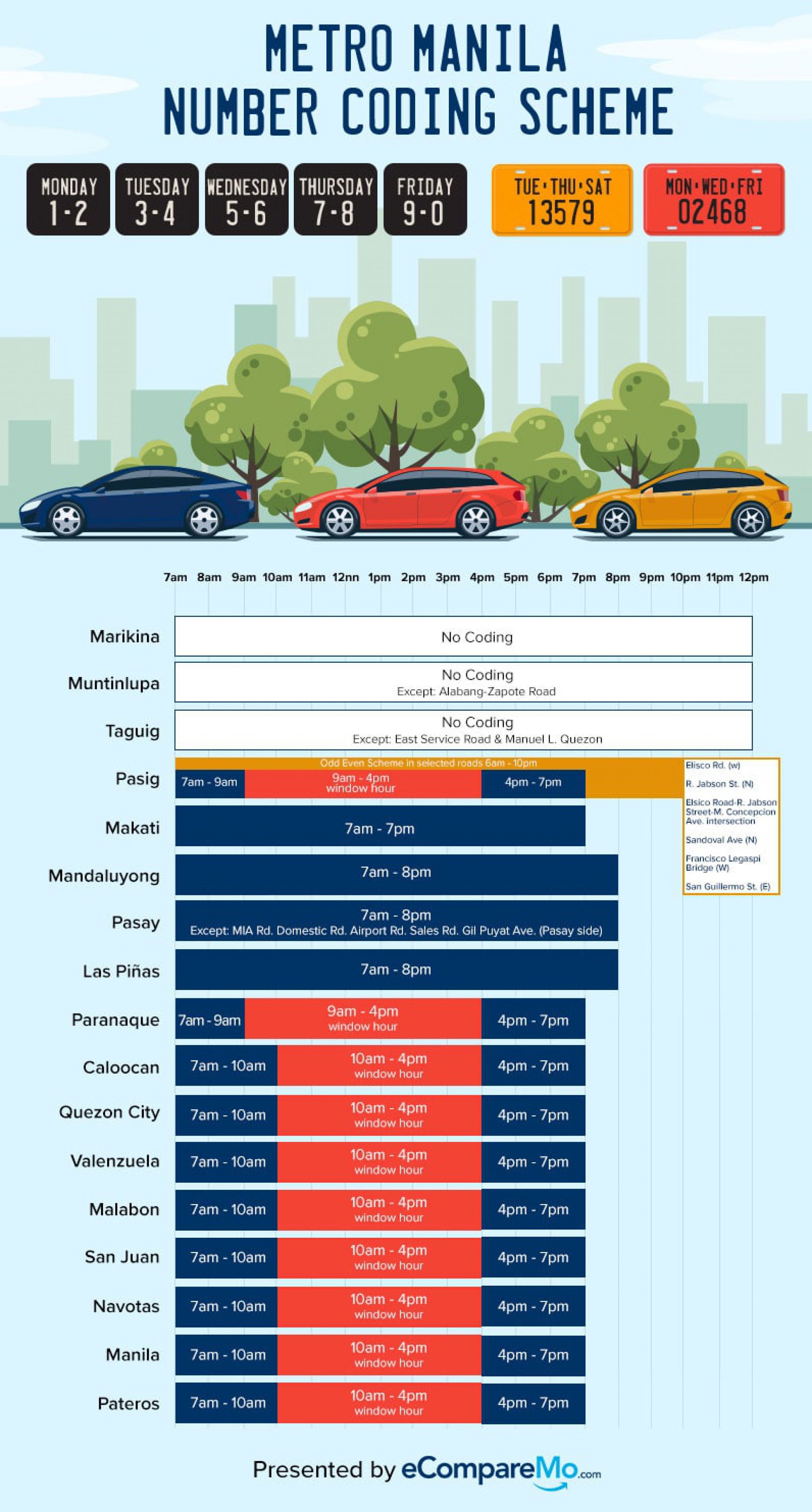
In a nutshell, the most recent version of the vehicle reduction program is as follows, with the specificities of some provisions discussed in depth below:
  • Vehicles are banned from Metro Manila roads based on the end of their plate numbers or conduction stickers, if the plates haven’t been released yet:
    • Monday: Plates ending in 1 and 2
    • Tuesday: Plates ending in 3 and 4
    • Wednesday: Plates ending in 5 and 6
    • Thursday: Plates ending in 7 and 8
    • Friday: Plates ending in 9 and 0
  • As of 2019, the restriction applies from 7 a.m. to 8 p.m.
  • Window hours don’t apply on major roads such as Edsa, the Circumferential Roads, and Roxas Boulevard
  • Public utility buses, both city and provincial, are not covered by window hours
  • Motorcycles are exempted to the rule
Sounds easy, right? However, you have to know by now that certain cities have their own rules regarding the UVVRP. Read along if you want to know more about them.

(Read: Know Your Rights On The Road: What Traffic Enforcers Can And Cannot Do)

Roads with no window hours

Before we get into the particulars of the metro-wide traffic decongestion scheme, you have to understand first which major roads in the capital do not respect the window hours. With the MMDA officials manning the big roads in Metro Manila, there’s no chance for you at all to squirm your way out of them:
  • Radial Roads:
    • R-1 Road (Bonifacio Drive to Roxas Boulevard)
    • R-2 Road (Taft Avenue in Manila to Diego Cera Avenue in Las Piñas)
    • R-3 Road (stretch of Osmeña Highway from the corner of Quirino Avenue to Nichols Interchange)
    • R-4 Road (Pasig Line Street, Kalayaan Avenue, Elizco Road)
    • R-5 Road (V. Mapa Street, P. Sanchez Street, Shaw Boulevard, Pasig Boulevard, Ortigas Avenue Extension)
    • R-6 Road (Legarda Street, Magsaysay Boulevard, Aurora Boulevard, Marcos Highway)
    • R-7 Road (Lerma Avenue, España Boulevard, Elliptical Road, Commonwealth Avenue, Quirino Highway)
    • R-8 Road (Quezon Boulevard, Alfonso Mendoza Street, Dimasalang Street, Bonifacio Avenue up to EDSA-Balintawak Interchange)
    • R-9 Road (Rizal Avenue, MacArthur Highway to Valenzuela-Meycauayan Bridge)
    • R-10 Road (from Anda Circle to C-4 Road in Navotas)
  • Circumferential Roads:
    • C-1 Road (Recto Avenue, Pedro Casal Street, Ayala Boulevard, Finance Drive, Padre Burgos Avenue)
    • C-2 Road (Capulong Street, Tayuman Street, Lacson Avenue, Quirino Avenue)
    • C-3 Road (C-3 Road Navotas, 5th Avenue, Sergeant E. Rivera Avenue, Gregorio Araneta Avenue, [upcoming] Metro Manila Skybridge, South Avenue, Ayala Avenue Extension, Gil Puyat Avenue)
    • C-4 Road (C-4 Road in Malabon, Paterio Aquino Avenue, Samson Road, EDSA)
    • C-5 Road (Mindanao Avenue Congressional Avenue, Luzon Avenue, Tandang Sora Avenue, Katipunan Avenue, Bonny Serrano Avenue, E. Rodriguez Jr. Carlos P. Garcia Avenue)
    • C-6 Road (from Napindan, Pasig to Lower Bicutan, Taguig)
  • Other major roads:
    • Alabang-Zapote Road
    • A. Mabini Street
    • Marcos Highway
    • McArthur Highway
Although there are no window hours on the major thoroughfares mentioned, you can cut through these roads by using secondary roads in certain cities. However, you have to know if a city you’re about to go through has window hours or not.

Not implemented

Not all cities have embraced the UVVRP. There are some territories that do not implement the number coding scheme at all. If you’re from these places, then you’re in luck:
  • Marikina
  • Muntinlupa
  • Taguig
Keep in mind that even if the aforementioned cities have chosen to not observe the rule, there still are provisions that supersede their authority.
Since the ban on major roads is more powerful than city-wide implementations, you have to remember the following exceptions to the no-number-coding rule on certain road portions within their respective territories:
  • Marikina: Marcos Highway
  • Muntinlupa: Alabang-Zapote Road
  • Taguig: C-5 Road (Carlos P. Garcia Avenue), C-6 Road, East Service Road, M.L. Quezon Street

(Read: UPDATE: Expect Heavier Traffic On Commonwealth Avenue Amid Closure Of Tandang Sora Flyover)

With window hours

Although some cities cannot implement a no-coding zone within their territories, they offer motorists affected by the day’s number coding scheme some window hours to go through their cities without fear of infractions.
Part of the reason they set the said periods is that they’re the lean traffic hours where most motorists have already gone to their respective destinations.
Cities with a window period between 10 a.m. and 3 p.m.:
  • Caloocan
  • Malabon
  • Manila
  • Navotas
  • Pateros
  • Quezon City
  • San Juan
Cities with a window period between 9 a.m. and 4 p.m.:
  • Parañaque
  • Pasig
Although Pasig offers some period of leniency to motorists affected by the day’s number coding scheme, it has its own odd-even vehicle scheme on top of the metro-wide one.
Confused? We’ve got you covered on the next part.

(Read: Provincial Buses To Be Banned On Edsa Starting April)

Pasig City’s odd-even number scheme

There’s no doubt that Pasig City’s traffic is horrendous, especially with a bulk of vehicles from Rizal funneled through the area.
Since the city already has bad traffic enough as it is, the city government implemented an odd-even scheme that runs from 6 a.m. to 10 p.m. during the following days:
  • Plates ending in 0, 2, 4, 6, 8: Banned from certain roads every Monday, Wednesday, and Friday
  • Plates ending in 1, 3, 5, 7, 9: Banned from certain roads every Tuesday, Thursday, and Saturday
  • No city-wide coding on Sundays
To make things more convoluted, this is only applicable on certain roads, namely:
  • Elisco Road westbound
  • R. Jabson Street northbound
  • Elsico Road-R. Jabson Street-M. Concepcion Avenue intersection
  • Sandoval Avenue northbound
  • Francisco Legaspi Bridge westbound
  • San Guillermo Street eastbound
If you’re coming from parts of Rizal and you want to cut through traffic via Pasig City’s network of streets, be sure to know this by heart or prepare to pay a fine of P500.

No window hours

Some cities are pretty generous with the UVVRP, either by not implementing it at all or offering a window time for motorists to use their cars. However, not everyone wants to play nice with drivers. Although you might find it frustrating, it is pretty understandable why they don’t have window periods at all.
The cities without window hours—meaning, the scheme is implemented there from 7 a.m. to 8 p.m.—are the following:
  • Las Piñas
  • Mandaluyong
  • Pasay (except for MIA Road, Domestic Road, Sales Road, and parts of Buendia within the city’s jurisdiction)
Meanwhile, Makati is somehow more generous with the window. Its coding period is from 7 a.m. to 7 p.m. only, giving people an early reprieve compared to others.

(Read: With The Road Board Abolished, Congress Now Gets To Decide Where To Use MVUC Funds)

Possible exceptions?

In 2011, the MMDA released a memorandum that defined which vehicles are automatically excluded from the UVVRP. If you’re one of the people covered by the automatic exemptions, then you’re in luck (although we highly doubt it):
  • Emergency vehicles like ambulance, police cars, and firetrucks
  • Cargo trucks exceeding 4,500 kilograms (they’re subject to the MMDA’s truck ban ordinance instead)
  • Vehicles commandeered by the government for emergency purposes
  • Vehicles ferrying a person that require immediate medical attention
  • Diplomatic vehicles (blue plate)
  • MMDA-accredited tow trucks
  • Government vehicles
Meanwhile, drivers and operators of the following vehicles can apply for an exemption from the UVVRP:
  • School buses and company shuttle for employees
  • Unmarked vehicles of media practitioners
  • Emergency car doctors
  • Persons with disabilities
  • Light commercial trucks carrying perishable goods
  • Department of Tourism-accredited vehicles

(Read: What To Do If You Get In An Accident With An Emergency Vehicle)

Good intentions, bad execution?

By the time you reach this portion, you probably know by now the biggest flaw of the UVVRP: if it is actually “unified,” why do Metro Manila governments have no singular number coding scheme? To understand this, you need to look at how power is structured in the National Capital Region.
Unlike in other parts of the country, the grouping of Metro Manila governments is more akin to administrative regions rather than a province. In the former, the governance of each component is left to their respective leaders while in the latter, there is a unifying government entity that promulgates rules that will affect all its constituting bodies.
For all metro-wide issues and projects, everything is being handled by the group of mayors called the Metro Manila Council. The policy-making entity is composed of the 17 mayors of NCR and the president is the MMDA Chairman.
Other members who have say in the issues include the presidents of Metro Manila Vice Mayors League and the Metro Manila Councilors League.
There are two reasons the Metro Manila Council cannot enact a singular number coding scheme for its members. First, the Local Government Code says that “highly urbanized cities and independent component cities shall be independent of the province.”
This way, each Metro Manila city has the right to implement their own traffic rules, except for major thoroughfares shared by cities, which is debated through the council.
Second, Metro Manila members do not directly answer to either the Metro Manila Council or the MMDA Chairman. Since the chairman is just a presiding officer in the council, he is not considered to be higher than the rest of the members. In fact, no metro-wide rule by the MMDA can be implemented without the Metro Manila Council’s green light.
The UVVRP may be considered burdensome by some people, especially those who drive their vehicles to get to work. When you feel the pain of not being able to take out your car during your “coding” day, just rationalize it by thinking you’re doing your part to ease the traffic, no matter how bad our vehicular flow is.